Note
This tutorial is generated from a Jupyter notebook that can be downloaded and run interactively.
Octree#
An octree is a tree data structure where each internal node has eight children. Octrees are commonly used for spatial partitioning of 3D point clouds. Non-empty leaf nodes of an octree contain one or more points that fall within the same spatial subdivision. Octrees are a useful description of 3D space and can be used to quickly find nearby points. CloudViewer has the geometry type Octree that can be used to create, search, and traverse octrees with a user-specified maximum tree depth,
max_depth.
From point cloud#
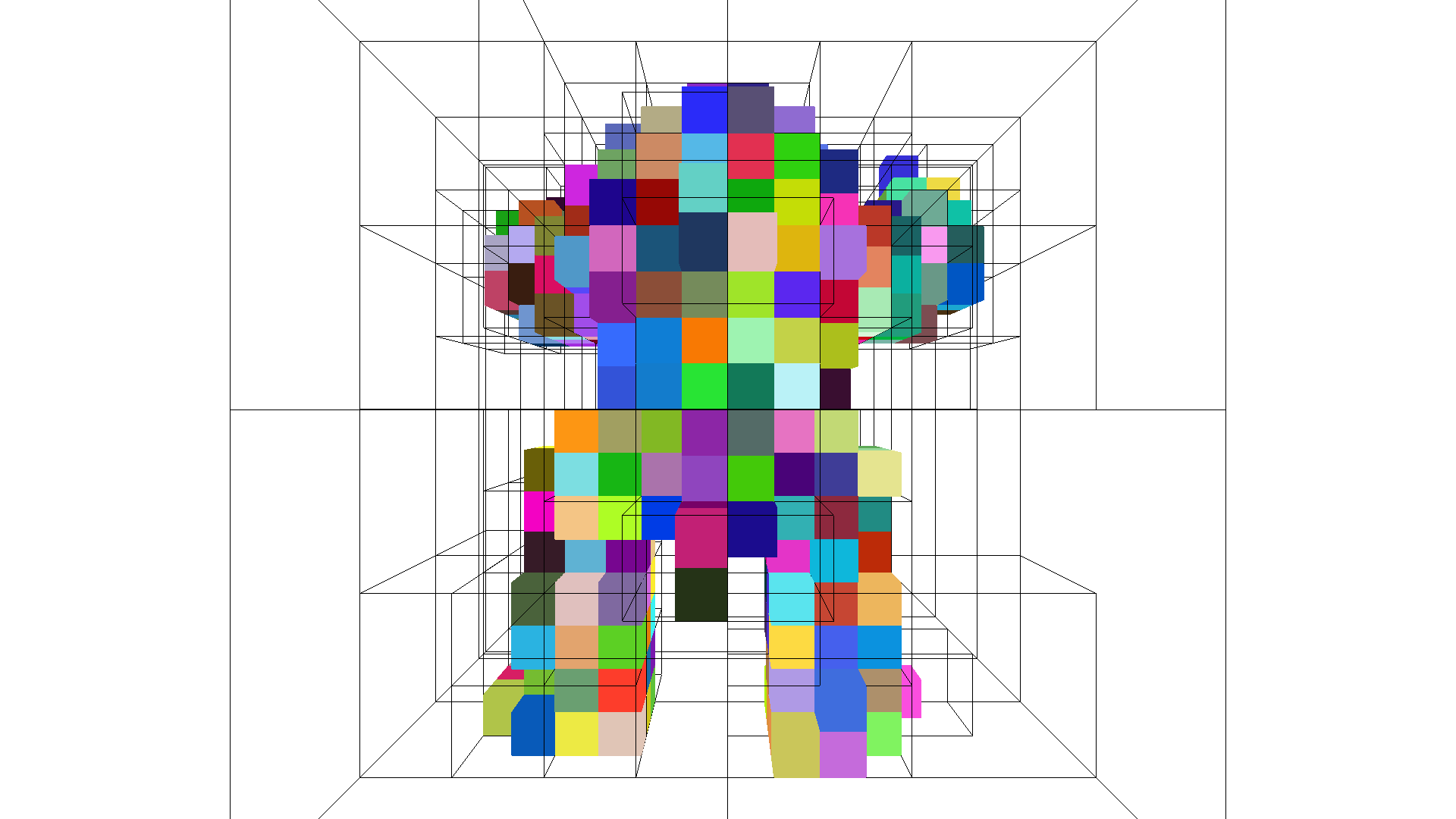
An octree can be constructed from a point cloud using the method convert_from_point_cloud. Each point is inserted into the tree by following the path from the root node to the appropriate leaf node at depth max_depth. As the tree depth increases, internal (and eventually leaf) nodes represents a smaller partition of 3D space.
If the point cloud has color, the the corresponding leaf node takes the color of the last inserted point. The size_expand parameter increases the size of the root octree node so it is slightly bigger than the original point cloud bounds to accomodate all points.
[2]:
print('input')
N = 2000
armadillo_data = cv3d.data.ArmadilloMesh()
pcd = cv3d.io.read_triangle_mesh(
    armadillo_data.path).sample_points_poisson_disk(N)
# fit to unit cube
pcd.scale(1 / np.max(pcd.get_max_bound() - pcd.get_min_bound()),
          center=pcd.get_center())
pcd.set_colors(cv3d.utility.Vector3dVector(np.random.uniform(0, 1,
                                                             size=(N, 3))))
cv3d.visualization.draw_geometries([pcd])

print('octree division')
octree = cv3d.geometry.Octree(max_depth=4)
octree.convert_from_point_cloud(pcd, size_expand=0.01)
cv3d.visualization.draw_geometries([octree])
input
[CloudViewer WARNING] GLFW Error: X11: The DISPLAY environment variable is missing
[CloudViewer WARNING] GLFW initialized for headless rendering.
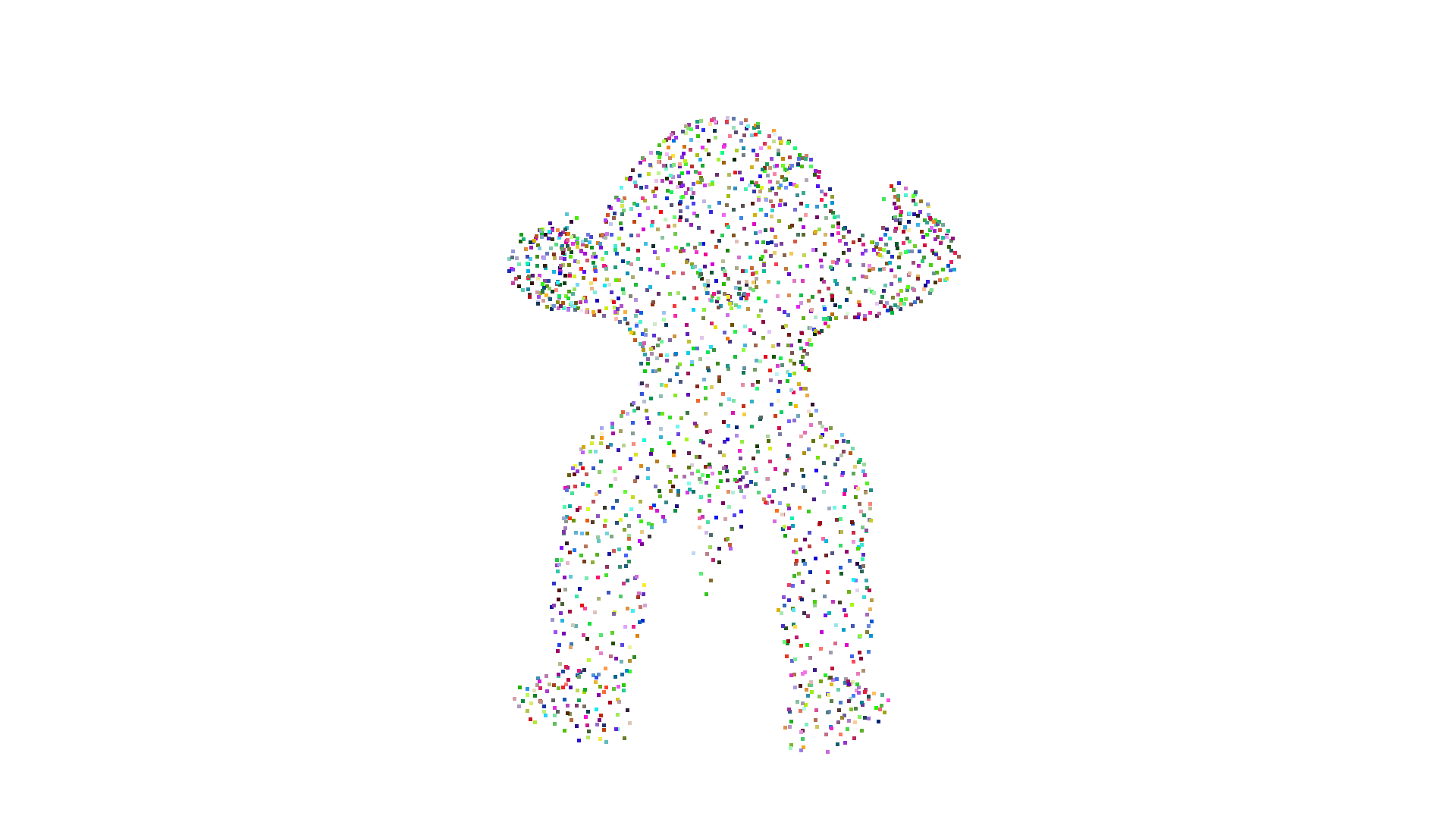
octree division
[CloudViewer WARNING] GLFW initialized for headless rendering.
From voxel grid#
An octree can also be constructed from an CloudViewer VoxelGrid geometry using the method create_from_voxel_grid. Each voxel of the input VoxelGrid is treated as a point in 3D space with coordinates corresponding to the origin of the voxel. Each leaf node takes the color of its corresponding voxel.
[3]:
print('voxelization')
voxel_grid = cv3d.geometry.VoxelGrid.create_from_point_cloud(pcd,
                                                             voxel_size=0.05)
cv3d.visualization.draw_geometries([voxel_grid])

print('octree division')
octree = cv3d.geometry.Octree(max_depth=4)
octree.create_from_voxel_grid(voxel_grid)
cv3d.visualization.draw_geometries([octree])
voxelization
[CloudViewer WARNING] GLFW initialized for headless rendering.
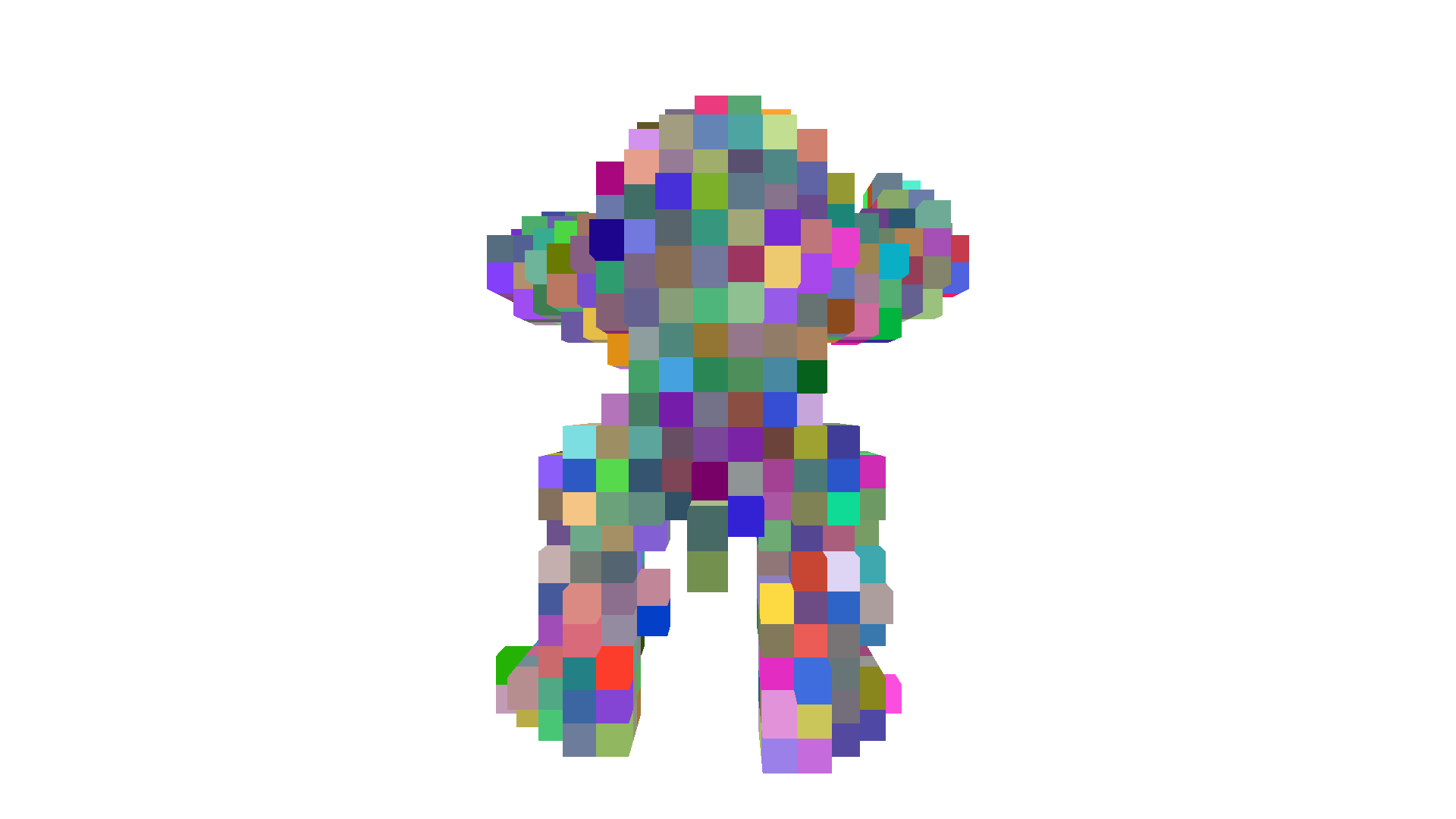
octree division
[CloudViewer WARNING] GLFW initialized for headless rendering.
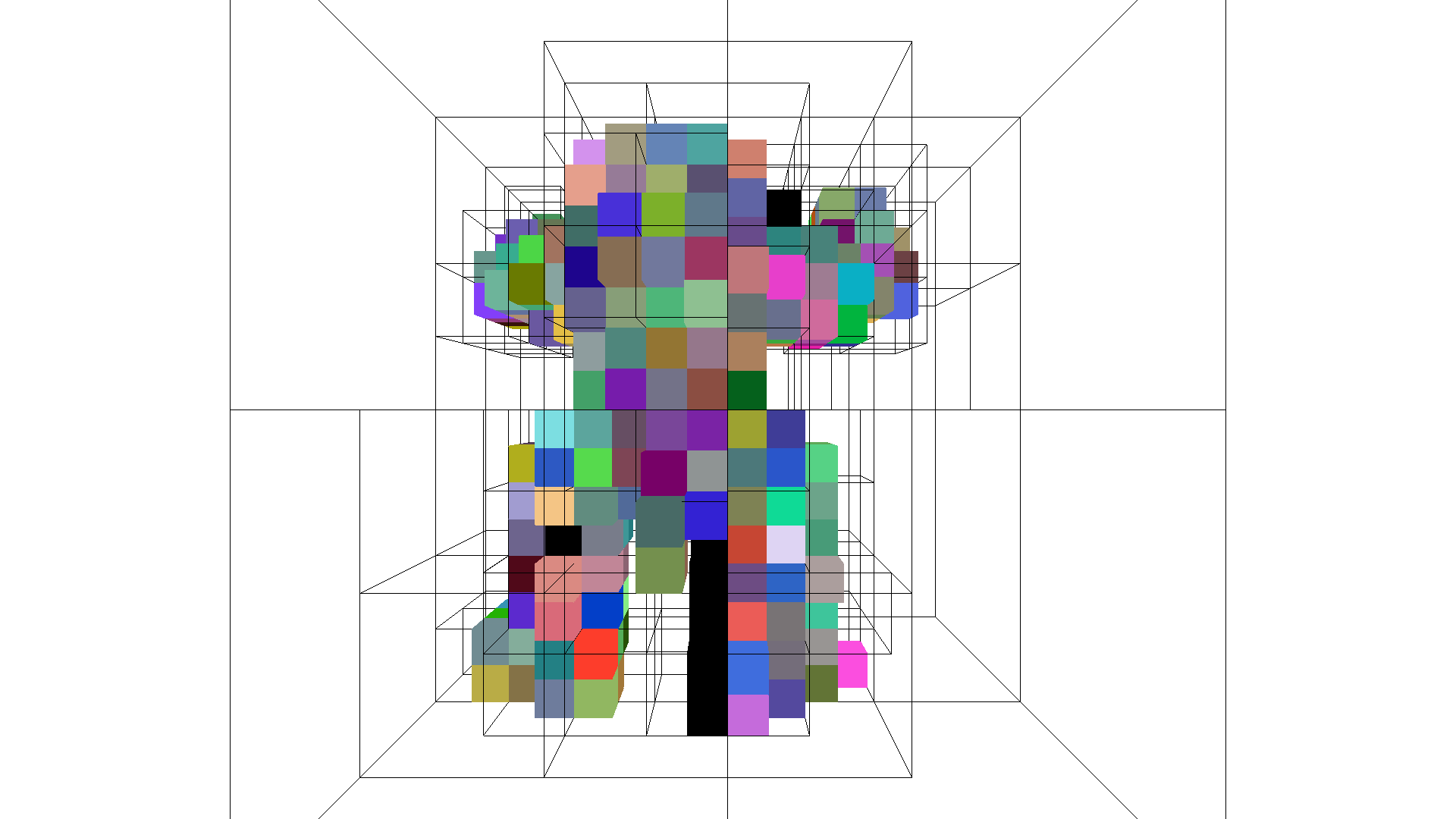
Additionally, an Octree can be coverted to a VoxelGrid with to_voxel_grid.
Traversal#
An octree can be traversed which can be useful for searching or processing subsections of 3D geometry. By providing the traverse method with a callback, each time a node (internal or leaf) is visited, additional processing can be performed.
In the following example, an early stopping criterion is used to only process internal/leaf nodes with more than a certain number of points. This early stopping ability can be used to efficiently process spatial regions meeting certain conditions.
[4]:
def f_traverse(node, node_info):
    early_stop = False

    if isinstance(node, cv3d.geometry.OctreeInternalNode):
        if isinstance(node, cv3d.geometry.OctreeInternalPointNode):
            n = 0
            for child in node.children:
                if child is not None:
                    n += 1
            print(
                "{}{}: Internal node at depth {} has {} children and {} points ({})"
                .format('    ' * node_info.depth,
                        node_info.child_index, node_info.depth, n,
                        len(node.indices), node_info.origin))

            # we only want to process nodes / spatial regions with enough points
            early_stop = len(node.indices) < 250
    elif isinstance(node, cv3d.geometry.OctreeLeafNode):
        if isinstance(node, cv3d.geometry.OctreePointColorLeafNode):
            print("{}{}: Leaf node at depth {} has {} points with origin {}".
                  format('    ' * node_info.depth, node_info.child_index,
                         node_info.depth, len(node.indices), node_info.origin))
    else:
        raise NotImplementedError('Node type not recognized!')

    # early stopping: if True, traversal of children of the current node will be skipped
    return early_stop
[5]:
octree = cv3d.geometry.Octree(max_depth=4)
octree.convert_from_point_cloud(pcd, size_expand=0.01)
octree.traverse(f_traverse)
0: Internal node at depth 0 has 8 children and 2000 points ([-2.94842315 30.83426857  2.12100744])
    0: Internal node at depth 1 has 4 children and 63 points ([-2.94842315 30.83426857  2.12100744])
    1: Internal node at depth 1 has 2 children and 44 points ([-2.44342315 30.83426857  2.12100744])
    2: Internal node at depth 1 has 8 children and 411 points ([-2.94842315 31.33926857  2.12100744])
        0: Internal node at depth 2 has 2 children and 8 points ([-2.94842315 31.33926857  2.12100744])
        1: Internal node at depth 2 has 1 children and 4 points ([-2.69592315 31.33926857  2.12100744])
        2: Internal node at depth 2 has 4 children and 41 points ([-2.94842315 31.59176857  2.12100744])
        3: Internal node at depth 2 has 1 children and 6 points ([-2.69592315 31.59176857  2.12100744])
        4: Internal node at depth 2 has 4 children and 63 points ([-2.94842315 31.33926857  2.37350744])
        5: Internal node at depth 2 has 5 children and 90 points ([-2.69592315 31.33926857  2.37350744])
        6: Internal node at depth 2 has 4 children and 72 points ([-2.94842315 31.59176857  2.37350744])
        7: Internal node at depth 2 has 6 children and 127 points ([-2.69592315 31.59176857  2.37350744])
    3: Internal node at depth 1 has 7 children and 359 points ([-2.44342315 31.33926857  2.12100744])
        0: Internal node at depth 2 has 1 children and 5 points ([-2.44342315 31.33926857  2.12100744])
        2: Internal node at depth 2 has 1 children and 3 points ([-2.44342315 31.59176857  2.12100744])
        3: Internal node at depth 2 has 2 children and 8 points ([-2.19092315 31.59176857  2.12100744])
        4: Internal node at depth 2 has 4 children and 83 points ([-2.44342315 31.33926857  2.37350744])
        5: Internal node at depth 2 has 4 children and 48 points ([-2.19092315 31.33926857  2.37350744])
        6: Internal node at depth 2 has 6 children and 109 points ([-2.44342315 31.59176857  2.37350744])
        7: Internal node at depth 2 has 5 children and 103 points ([-2.19092315 31.59176857  2.37350744])
    4: Internal node at depth 1 has 5 children and 345 points ([-2.94842315 30.83426857  2.62600744])
        0: Internal node at depth 2 has 4 children and 59 points ([-2.94842315 30.83426857  2.62600744])
        1: Internal node at depth 2 has 4 children and 100 points ([-2.69592315 30.83426857  2.62600744])
        2: Internal node at depth 2 has 2 children and 22 points ([-2.94842315 31.08676857  2.62600744])
        3: Internal node at depth 2 has 8 children and 144 points ([-2.69592315 31.08676857  2.62600744])
        7: Internal node at depth 2 has 1 children and 20 points ([-2.69592315 31.08676857  2.87850744])
    5: Internal node at depth 1 has 4 children and 322 points ([-2.44342315 30.83426857  2.62600744])
        0: Internal node at depth 2 has 8 children and 175 points ([-2.44342315 30.83426857  2.62600744])
        1: Internal node at depth 2 has 1 children and 1 points ([-2.19092315 30.83426857  2.62600744])
        2: Internal node at depth 2 has 8 children and 143 points ([-2.44342315 31.08676857  2.62600744])
        6: Internal node at depth 2 has 1 children and 3 points ([-2.44342315 31.08676857  2.87850744])
    6: Internal node at depth 1 has 6 children and 238 points ([-2.94842315 31.33926857  2.62600744])
    7: Internal node at depth 1 has 6 children and 218 points ([-2.44342315 31.33926857  2.62600744])
Find leaf node containing point#
Using the above traversal mechanism, an octree can be quickly searched for the leaf node that contains a given point. This functionality is provided via the locate_leaf_node method.
[6]:
octree.locate_leaf_node(pcd.get_point(0))
[6]:
(OctreePointColorLeafNode with color [0.827451, 0.0745098, 0.435294] containing 1 points.,
 OctreeNodeInfo with origin [-2.82217, 31.5918, 2.18413], size 0.063125, depth 4, child_index 4)