 |
ACloudViewer
3.9.4
A Modern Library for 3D Data Processing
|
|
ACloudViewer
3.9.4
A Modern Library for 3D Data Processing
|
Plain C Tensor object, does not manage memory. More...
#include <DLPack.h>
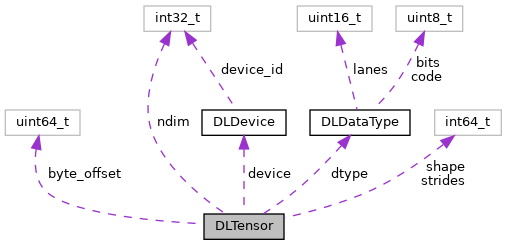
Public Attributes | |
| void * | data |
The data pointer points to the allocated data. This will be CUDA device pointer or cl_mem handle in OpenCL. It may be opaque on some device types. This pointer is always aligned to 256 bytes as in CUDA. The byte_offset field should be used to point to the beginning of the data. More... | |
| DLDevice | device |
| The device of the tensor. More... | |
| int32_t | ndim |
| Number of dimensions. More... | |
| DLDataType | dtype |
| The data type of the pointer. More... | |
| int64_t * | shape |
| The shape of the tensor. More... | |
| int64_t * | strides |
| strides of the tensor (in number of elements, not bytes), can not be NULL if ndim != 0, must points to an array of ndim elements that specifies the strides, so consumer can always rely on strides[dim] being valid for 0 <= dim < ndim. More... | |
| uint64_t | byte_offset |
| The offset in bytes to the beginning pointer to data. More... | |
| uint64_t DLTensor::byte_offset |
| void* DLTensor::data |
The data pointer points to the allocated data. This will be CUDA device pointer or cl_mem handle in OpenCL. It may be opaque on some device types. This pointer is always aligned to 256 bytes as in CUDA. The byte_offset field should be used to point to the beginning of the data.
Note that as of Nov 2021, multiple libraries (CuPy, PyTorch, TensorFlow, TVM, perhaps others) do not adhere to this 256 byte alignment requirement on CPU/CUDA/ROCm, and always use byte_offset=0. This must be fixed (after which this note will be updated); at the moment it is recommended to not rely on the data pointer being correctly aligned.
For given DLTensor, the size of memory required to store the contents of data is calculated as follows:
Note that if the tensor is of size zero, then the data pointer should be set to NULL.
| DLDataType DLTensor::dtype |
| int64_t* DLTensor::shape |
| int64_t* DLTensor::strides |
strides of the tensor (in number of elements, not bytes), can not be NULL if ndim != 0, must points to an array of ndim elements that specifies the strides, so consumer can always rely on strides[dim] being valid for 0 <= dim < ndim.
When ndim == 0, strides can be set to NULL.
 1.9.1
1.9.1